OpenAI makes four
OpenAI's Decisions API (gpt-6-luna, public beta) as a BEIR reranker: 0.472 mean nDCG@10 in its best shape, behind Jev and Perplexity at 0.501, with peaked probabilities that break the 0.1 prune.
adam hevenor
AI, search, and agentic engineering consulting.
I help CTOs turn their engineering org into a technical staff that directs agents toward outcomes. I run my own practice that way — hev layer, hev kit, and hev ask are what it ships.


the lead bet — hev layer
The search engineering layer: a transparent, turbopuffer-shaped proxy that makes an existing vector store better without changing client code. Query routing reads the shape of a request and picks vector, lexical, or hybrid with RRF fusion. Typo-tolerant surfacing returns near-misses with a badge saying why. It takes on the jobs your search team never asked for — caching, transforms, embedding, cost, and ops.
I help teams align strategically, then move with them to help elevate the pace. Client engagements fund my R&D, allowing my clients to benefit directly from my research. -> about Adam
 case study · Trio Health A search api that became an agentic platform
  case study A two-week CLI sprint for an LLM evals platform
  case study · Taffrail An MCP server for a wealth-advisory rules engine r&d · active hev dots
  r&d · active hev layer
  r&d · active hev kit
  r&d · experiment hev ask
showcase
A travel publication, built whole — destination guides, illustrated art direction, search, accounts. Next up: an agentic trip app builder.
-> travels-with-charlie.com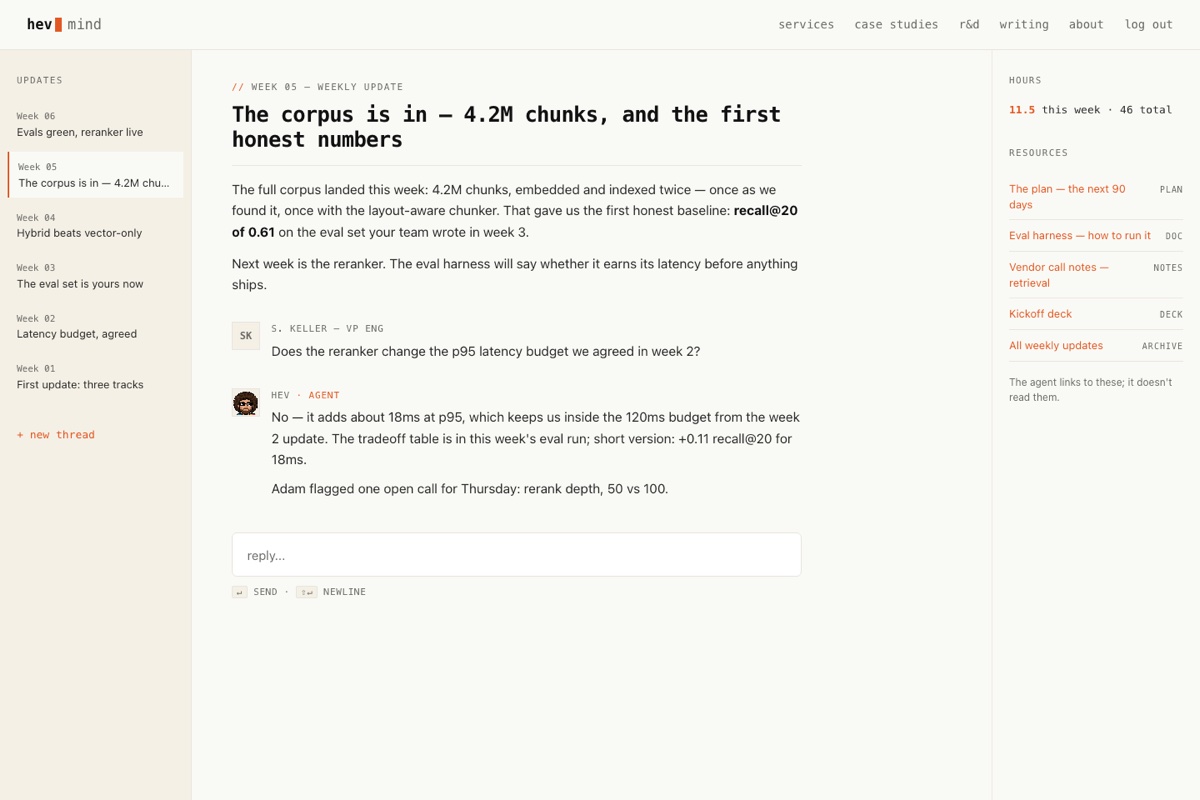
the client workspace
Built around weekly updates I write myself — what landed, what's next, what's blocked. The agent answers on top of them, grounded in the plan, the hours, and everything we produce. Yours to keep. Shown: an example week.
-> book a time Workshops A hands-on half day with your team: operating an agent factory, evals from zero, KPIs that drive behavior, or one shared vocabulary across your leadership. Your team leaves with something working.
  Research Plan A hosted plan for the question you're actually trying to answer — what to learn, from whom, in what order, and what would change your mind. Your team marks progress against it and interrogates it with an agent.
  Research Program The plan, and I run it. Six interviews with people who can answer the question, then the insight analysis: what the market said, where it contradicts your roadmap, and what to do about that.
  Search & Retrieval POV A proof of value on your own corpus. Evals first, so "better" is a number you can defend, then hybrid, reranking, chunking, and the vector database call, argued from your data. You keep the eval set and the system.
  Fractional CTO I run a factory on your codebase. Agents do the volume, I own the review gate. Around that: architecture, vendor selection, hiring judgment, and delivery rhythm.
  Hourly Data engineering, ML, and strategy work billed by the hour — for a bounded problem, a second opinion, or ad-hoc help when you don't need a standing engagement.
 OpenAI's Decisions API (gpt-6-luna, public beta) as a BEIR reranker: 0.472 mean nDCG@10 in its best shape, behind Jev and Perplexity at 0.501, with peaked probabilities that break the 0.1 prune.
Jev, Clef-flash and Perplexity's pplx-decider as BEIR rerankers: Perplexity's choice shape edges Jev on quality and price, Jev is faster and scores each document, and Clef-flash needs one call per document.
Building your own SOTA reranker is now highly achievable. I pointed TypeSafe's new structured-output model at three BEIR datasets, untuned, and it landed next to the purpose-built rerankers on quality, price, and latency.
Talk abstract. Reading the vector pricing calculators, linking features to outcomes, and what else decides it anyway — existing search systems, AWS credits, and how fast your data grows.